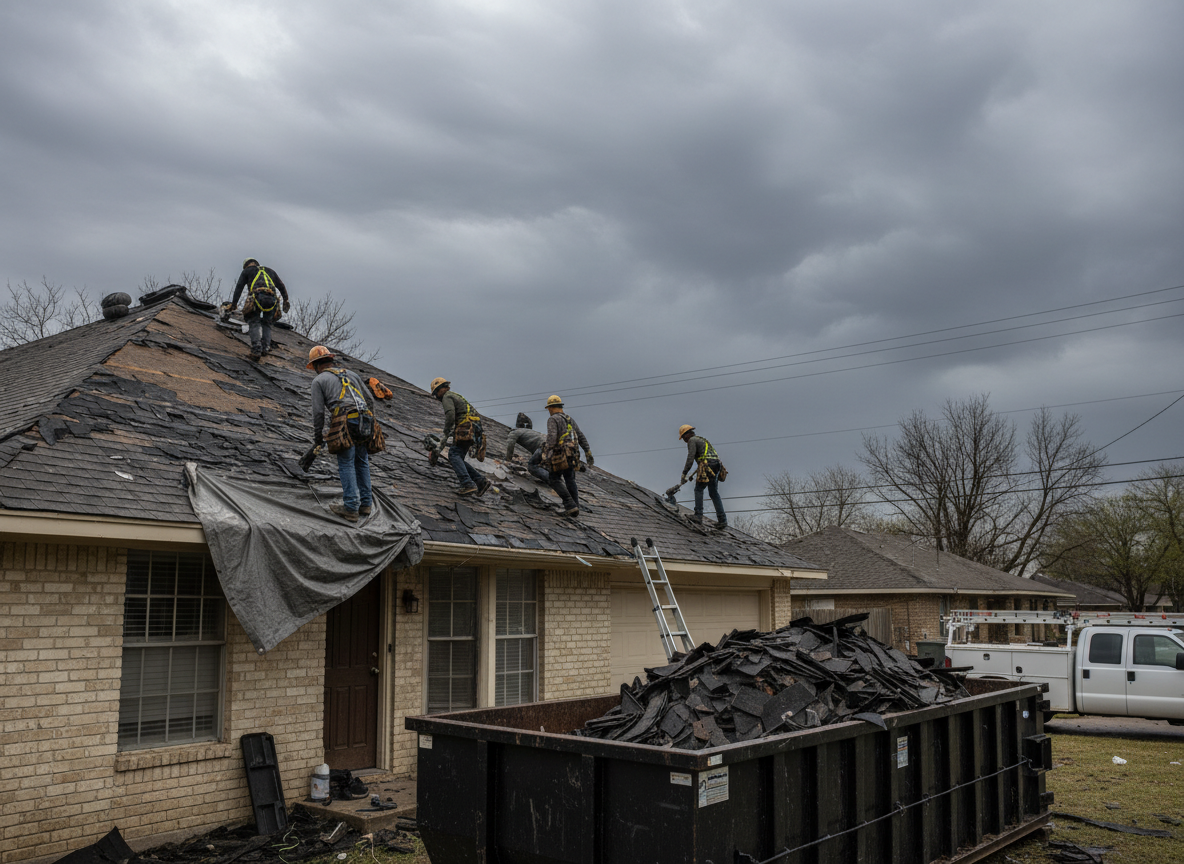
Storm damage on a roof is a matter of evidence, and the evidence is physical. Hail leaves impact marks and bruises the mat under the granules. Wind creases shingles, lifts edges and folds ridge caps. Debris punches, scuffs and abrades. Each of those leaves a different signature, and distinguishing them from ordinary wear is the whole job, because a roof that has been hit by a storm is repaired while a roof that has simply aged is maintained or replaced. Storm and hail damage repair is the work that follows a correct reading of what the roof actually shows.
What Hail Physically Does
A hailstone is ice travelling at speed. When it strikes a shingle it does two things at once: it displaces granules from the surface, and it transfers energy into the mat below. The displaced granules are the part you can see. The bruised mat is the part that matters, because a shingle whose reinforcing mat has been fractured has lost the strength that keeps it from tearing in the next wind.
The distinction between cosmetic and functional damage is where most disputes sit. A few missing granules on a weathered shingle is not the same as a soft, bruised spot where the mat has been broken and the shingle flexes under a thumb. Inspectors look for the second, and a repair scope should describe which is being addressed.
Impact testing is also built into products. Asphalt shingles carry impact-resistance classifications under a standard four-class rating, and a Class 4 shingle is specified in hail-prone markets precisely because a heavier stone does not fracture it as readily. Where a roof was built with an impact-rated product and still failed, the failure is more likely to be at a penetration or a flashing than in the field.
Soft metals are the corroborating evidence. Hail dents aluminium and copper: vent hoods, ridge vents, gutters, downspouts, valley metal, flashing caps and the tops of air-conditioning units. A roof with dented metals and unmarked shingles, or the reverse, tells a story about the storm's path.
What Wind Does
Wind does not bruise; it pulls. The failure starts at edges, corners and ridges where the pressure difference is greatest. A tab lifts, the sealant strip that held it down gives way, and the next gust folds it back. Once a tab is creased it will not lie flat again, and the seal that kept water out of the layer below is gone even if the shingle is still attached.
Wind-driven rain is the companion problem. A roof can survive the pressure and still admit water through the joints the wind has just loosened. That is why a storm-damaged roof often leaks at a detail that looks intact from the ground.
Debris is the third mechanism: a limb, a tile, a piece of neighbouring roof, or a chunk of hail-driven gravel. The result is mechanical damage with a clear impact point, and the repair is a physical one.
How the Assessment Runs
The visit starts with the elevations and the details rather than the field. Ridge lines, hips, valleys, edges, penetrations, wall junctions, gutters and soft metals are photographed first, because those are where damage concentrates and where the evidence is easiest to lose.
Then the field, walked in a pattern so that no slope is skipped, with close photographs of anything marked. Chalk is used to circle impact marks so they can be counted and photographed at a consistent scale.
Then the interior. Staining, damp timbers and daylight through the deck are recorded, because the interior evidence is what connects the roof damage to the building.
Then the written result: what is storm damage, what is wear, what is unrelated, and what needs repair now. That distinction belongs in writing, with photographs, because the same document serves the repair, the insurer and any future survey.
The Repair Itself
Hail and wind repairs fall into a small number of categories.
Field shingle replacement covers bruised or creased shingles, replaced course by course with matching material and new fasteners. On an older roof the colour match is imperfect, which is a cosmetic outcome, not a defect.
Detail renewal covers the parts that fail first: vent boots, step flashing, valley metal, ridge caps, drip edge and the seals around penetrations. These are replaced as complete details rather than patched, because a boot or a flashing that has been bruised rarely holds a sealant for long.
Deck repair is sometimes necessary where impact has broken through, where a limb has punctured, or where water has been entering long enough to delaminate sheathing. It is discovered during the repair, not before it, and a scope should say so.
Soft metal replacement covers gutters, valleys, vents and flashing caps where the damage is denting rather than perforation. Dented gutter sections still work; they are replaced for appearance or because the dents have opened seams.
When a Storm Roof Is Beyond Repair
There are roofs where the honest answer is replacement rather than repair. A roof already at the end of its underlayment life that then takes a hail event is a roof where repair money is spent twice. A roof where damage is spread across most slopes cannot be repaired economically in sections. A roof with widespread mat bruising across every plane has lost the surface that sheds water, even if it is not leaking today.
That conclusion should be supported by photographs and a count of impact marks rather than asserted. If most of the roof shows functional impact damage, the repair conversation is short; if the damage is concentrated at details, it is a repair job.
Regional Differences That Change the Work
In the South Central states the hail question dominates. Texas, Oklahoma, Kansas, Colorado, Missouri and Arkansas sit in the corridor with the highest frequency of large hail in the country, and the hail season peaks in spring. Texas also has its own certification route for windstorm-resistant construction in designated catastrophe areas, which affects how a replacement is documented even when the repair is a small one.
On the Southeast coast the storm question is wind and water rather than ice. Roofs there are designed for uplift, the covering systems are approved products under state product-approval rules, and inside the High-Velocity Hurricane Zone of Miami-Dade and Broward the requirements are stricter still. Wind-driven rain at wall junctions is a regional failure mode that no roof repair addresses.
In the Midwest and Northeast the storm that damages roofs is often a winter one: ice, snow load, freeze-thaw and nor'easters. Damage here is frequently at the eaves, where ice has backed water under the courses, or at valleys where snow has sat and refrozen.
In the Mountain West and the arid interior, hail still occurs and can be severe along the Front Range and the high plains, but the more common storm damage is wind and monsoon rain arriving on a roof whose sealants have already been degraded by ultraviolet exposure.
What to Send When You Call
The state and city, the covering type, the approximate age of the roof, and photographs if you have them. Whether the roof is currently leaking. Whether the damage is visible from the ground or only from close up. Whether an insurer has already been involved.
Call (833) 406-0167. The first question is always what the roof shows, because the answer decides whether this is a repair, a replacement, or a documented record for a claim.
Matching a Repair to a Roof That Is Already There
Most storm repairs are done on a roof that has been weathering for years, and matching new material to old is part of the craft. Shingle colours fade, granules weather away and profiles are discontinued, so a repaired area will usually read as a repair from close up. What matters is that the replacement matches in weight, exposure and rating, so the patched area behaves like the rest of the roof rather than becoming its weakest point.
Where a colour or profile is no longer made, the honest options are to use the closest current equivalent or to replace the whole slope rather than leave a mismatched patch in the middle of a field. Neither is a defect. What is a defect is a repair that introduces a lighter shingle, a different exposure or a fastener pattern that does not match, because that area will fail first.
What Is Found After the Covering Comes Off
Storm damage is assessed on the surface, and repairs are made underneath it. That gap is where surprises live: sheathing that is soft from water that entered months earlier, underlayment that has torn where a tab lifted, or a deck that was never properly fastened in the first place.
A written scope should therefore be explicit about how discovered work is handled. The usual arrangement is that the visible storm repair is priced and agreed, and anything found beneath the covering is photographed and agreed before it is added. That protects both sides from a conversation after the fact, and it keeps the roof from being closed over a problem that will reopen the repair within a season.
What the Storm Report Includes
A storm assessment includes the evidence, not just a verdict. Impact marks counted and photographed, soft metals checked for denting, creased tabs and displaced ridge caps recorded, and the interior examined for water that has already travelled. It includes a written separation of storm damage from wear, item by item, and a statement of what was not accessible. Where a repair follows, the scope lists the materials, the quantities and the labour as separate lines so it can be compared with another.
How it works
- 1
Inspect the details first
Ridges, hips, valleys, edges and penetrations, photographed before the field is walked.
- 2
Assess the field in a pattern
Every slope walked, impact marks circled and counted, creased tabs recorded.
- 3
Separate storm from age
A written distinction between functional damage, cosmetic marking and ordinary wear.
- 4
Repair the damaged details
Shingle courses, boots, flashing and ridge caps renewed as complete details.
- 5
Document the outcome
Dated photographs and a note that stands up to an insurer, a survey or a future sale.