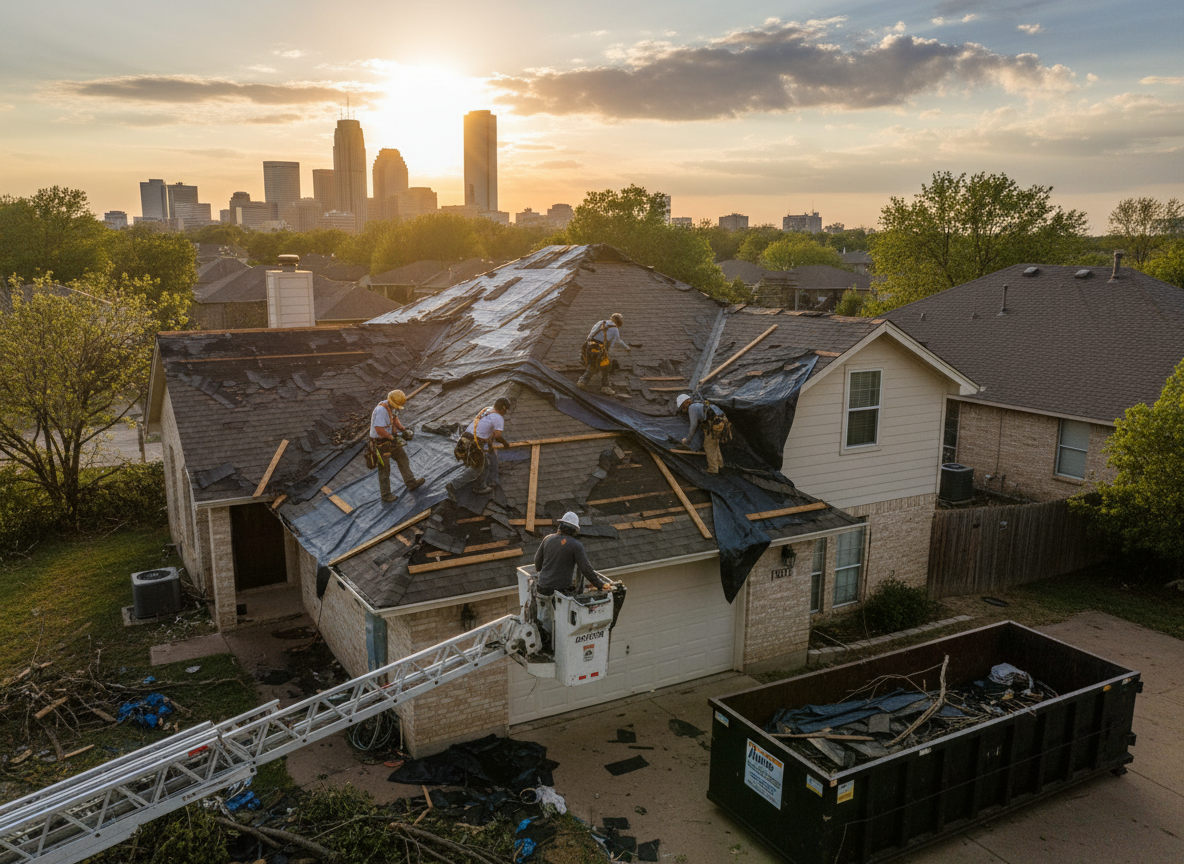
The call usually comes at night, and it usually comes from someone standing in a hallway holding a torch. Water is running down the inside of an exterior wall, or dripping through a ceiling rose, or spreading in a dark patch across a bedroom ceiling while rain continues outside. Where that house is makes very little difference to the first hour. Whether it sits under a hail core in the Texas Panhandle, in a feeder band on the Florida coast, beneath a lake-effect snow band in Michigan or under a monsoon cell in Arizona, the problem on the phone is the same: water is inside a building that is supposed to be dry, and nobody knows yet where it is getting in. Emergency roof repair is the work of stopping that water from spreading through the structure tonight and leaving a written, dated record of what was found. In the United States that number is (833) 406-0167.
What Emergency Roof Repair Actually Covers
Emergency work is not a smaller version of a normal repair visit. It is a different job with a different order of operations, and it has three common shapes.
An active leak with no obvious opening
Water is entering and the roof looks intact from the ground. This is the most common night call and the most commonly misdiagnosed one. Water that shows at a ceiling does not necessarily enter above that ceiling: it can travel along a rafter, a batten or the underside of a deck for several metres before it finds a joint to drip through. The visit is a trace, working from the wet point backwards through the attic or the ceiling void to the detail that is actually failing.
A storm-created opening
Shingles torn away, ridge caps lifted and folded back, a tile course displaced, a metal panel peeled at a corner, a vent boot split, or a tree limb through the deck. Here the entry point is visible and the work is to close it, secure anything loose that could fall, and stop the opening from taking on more water while the permanent repair is planned.
Water arriving where there is no roof damage at all
Wind-driven rain forced against a wall does not need a hole. It finds the joints a wall always has: the head of a window, a stucco or cladding crack, the junction where roof meets wall, an abandoned cable penetration, a weep screed that has lost its seal. Nothing on the roof field is broken, and a tarp over the roof will not touch it. These calls cluster during named storms and during the violent convective systems of the southern plains, and they need a different temporary measure: work at the elevation that is leaking, not on the slope above.
What's Included in a Proper Emergency Visit
An emergency visit should leave you with more than a dry patch of ceiling. The record matters as much as the repair, because it is what every later conversation rests on: the permanent repair, an insurance claim, a sale, a dispute with a contractor who came before.
The main column list on this page sets out the six items. In plain terms they are the dated photographs taken during the visit rather than after the fix, a written description of the water path from entry to interior, an itemised note of the make-safe work and the materials used, the permit position for the permanent repair, the name of the office that will issue it, and contact details that do not change between visits.
Two of those are worth insisting on. The photographs should be dated, because a claim or a warranty conversation is always about when. The permit position should be in writing, because whether a repair needs a permit depends on the state, the county and the scope, and a roofer who cannot say which office covers your address has not yet thought about the permanent job.
How the Visit Runs, and What It Cannot Do
The first part happens on the phone. Where is the water showing? Is it running, dripping or only staining? When did it start, and does it appear only when the wind drives rain at a particular wall? Has the roof been repaired, replaced or patched before? Those answers decide whether the visit is a trace, a temporary cover, or simply a redirect of water away from the building until daylight.
On site the order is interior first. The wet timber, the extent of the stain and the height at which the moisture stops narrow down which detail is involved. Only then does anyone go onto the roof, and only where it is safe to do so: a wet roof under an active storm is a fall risk and a lightning risk, and no useful repair is done by someone who cannot see the surface they are standing on.
By the end of the visit you should know three things. What was done tonight. What it is protecting. And what the permanent repair is likely to involve, described in the language of details rather than the language of sales.
What an emergency visit cannot do is finish the job. Underlayment cannot be judged in the dark, deck condition cannot be confirmed through a temporary cover, and colour and profile matching needs daylight. Anyone promising a complete permanent repair on the same night, in the middle of the weather that caused the damage, is describing something they cannot deliver.
How Emergency Response Differs Across the Country
The hail belt
From Texas through Oklahoma, Kansas, Colorado, Missouri and Arkansas, emergency calls after hail are rarely about a single dramatic hole. They are about a roof that has been hit by hundreds of stones and has started to leak at the weakest details: a vent boot cracked by impact, a valley where granules have been driven off, a ridge cap whose sealant has been bruised. The roof can look broadly intact while water finds its way through one compromised penetration. Emergency work here is often a single detail, and the permanent conversation is about the pattern of impact across the whole surface.
The hurricane coast
Along the Gulf and the southern Atlantic seaboard the emergency problem is uplift and lateral drive. Edges, corners and ridge lines take the highest wind loads, and once an edge lifts, water enters at the perimeter and runs inward. Wind-driven rain then pushes through wall junctions and around openings that were never designed to face sustained horizontal water. In the High-Velocity Hurricane Zone of Miami-Dade and Broward counties the permanent repair is governed by an additional chapter of the Florida Building Code, and every covering and fastening method has to come from an approved product system.
The snow-load north
Across the upper Midwest, the Great Lakes snow belts and the Northeast, emergency calls arrive in a different form: a ceiling stain that appears during a thaw, an ice dam at the eaves backing water under the courses, or a roof that has carried more weight than its framing was designed for. Water here often enters high and shows low, and the temporary fix is frequently about stopping meltwater rather than stopping rain. Snow load is not uniform: ground snow load values change with elevation and proximity to the Great Lakes, and a roof built for one value should not be treated as if it were built for another.
The arid west
In Arizona, Nevada, New Mexico, Utah and the mountain states of the interior, a roof can be baked for months and then hit by a short, violent monsoon storm in July, August or September. The failure mode is thermal: sealants have hardened, flashings have moved, tile underlayment has embrittled, and the first real rain finds every one of those. Emergency work on a desert roof is often less about wind damage than about water arriving on a surface whose details have aged faster than its covering.
What to Do Before Anyone Arrives
Move what you can out from under the leak and put a bucket where the water is landing, not against a wall where it will spread. Photograph everything before you tidy: the stain, the drip, the floor beneath it, the ceiling from a distance. If water is anywhere near a light fitting, a switch or a distribution board, stop using that circuit and keep everyone away from it. If a ceiling is bulging, do not stand under it and do not push at it. Do not climb onto a wet roof in the dark to look for the hole, and do not seal a detail that a later inspection will need to see.
Nothing you do on the ground will stop the water, and that is fine. The purpose of those steps is to limit what gets wet and to preserve the evidence that explains why it did.
Call (833) 406-0167, describe what you can see, and say which state and city the building is in. The climate, the code and the covering all change the answer, and the first useful question is always where the roof actually is.
How it works
- 1
Describe the problem by phone
Where the water shows, when it appears, which direction the weather was coming from, and whether the roof has been worked on before.
- 2
Work from the interior out
The wet timber and the extent of the stain narrow the search before anyone goes onto the roof.
- 3
Make safe and cover
Close what can be closed, secure what is loose, and protect what cannot be repaired until daylight.
- 4
Photograph and record
Dated photographs, a written water path and an itemised note of what was done on the visit.
- 5
Scope the permanent repair
Materials, quantities, labour and the permit route, written so another estimate can be compared with it.